The “Invasion” as Seen by the Wild Island Animals
My Father's DragonThe “Invasion” as Seen by the Wild Island Animals is the animals’ escalating but mistaken interpretation of Elmer Elevator’s passage across Wild Island. Fresh Tangerine peels, reports of a rock that vanishes, and the animals’ own inexplicable distractions become clues in a theory of invasion. The misunderstanding gives Elmer’s practical improvisations a second life: what helps him evade individual animals also makes the island’s inhabitants more certain that an intruder is among them.
The First Signs
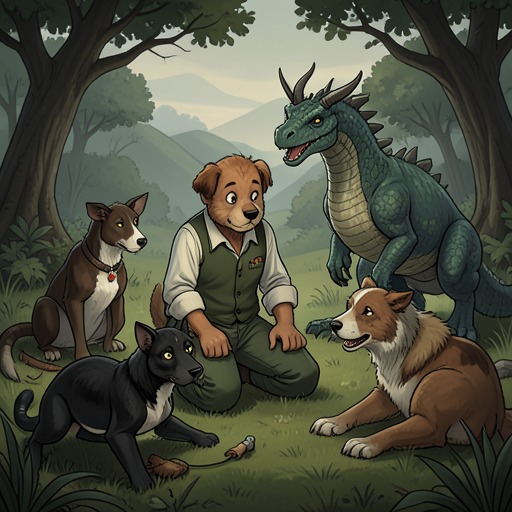
The suspicion begins with a pair of Wild Boars trying to make sense of reports near the Ocean Rocks. Their list of signs combines fresh Tangerine peels beneath a wahoo bush, a Mouse’s report of an extraordinary rock that was gone when investigated, and more peels at the place where the rock had supposedly appeared. Since Tangerines do not grow on Wild Island, the first boar reasons that someone must have carried them across the Ocean Rocks; he connects that possibility, cautiously but unmistakably, to the rock’s appearance and disappearance.
The theory is not accepted without question. After a long silence, the second boar proposes that the peels could have floated over by themselves and dismisses the Mouse’s report as unreliable. He also takes his own failure to witness an invasion as evidence against one. The first boar yields, and both return to the jungle. Their withdrawal does not resolve the clues; it merely suspends the explanation. Elmer, who has overheard them, draws a practical lesson from the discussion and begins saving his Tangerine peels rather than leaving them behind. The animals’ tentative deductions therefore change the way he travels, even before they become an organized search.
Evidence Multiplies
Later, the earlier reports acquire a new complication when a Wild Boar recounts the tortoises’ mistaken sighting of a monkey apparently carrying his sick grandmother to a doctor. The grandmother had died a week earlier, so the sighting cannot mean what the tortoises thought it meant. Instead of closing the matter, that contradiction makes the boar wonder what they actually saw. The second boar treats the discrepancy as confirmation that an invasion is under way and declares his intention to investigate.
The two boars then divide the search. One is to follow the trail toward the Baby Dragon; the other will return through the big clearing, while the Mouse watches the Ocean Rocks in case the supposed invader leaves before it is found. Their response turns private suspicion into a coordinated, if improvised, pursuit. Elmer is nearby, hidden behind a mahogany tree. He waits only briefly before continuing, anticipating that the boar returning from the clearing will become still more suspicious after seeing the Tigers occupied with chewing gum.
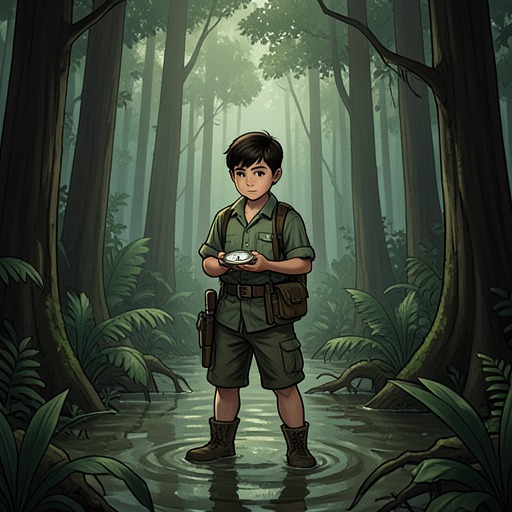
The peels remain both clue and countermeasure. When Elmer later stops beneath a baby banyan tree, he eats four of his remaining thirteen Tangerines, wants more but keeps the limited supply in mind, and packs away every peel. The small arithmetic of his provisions has a larger consequence: the animals have already taught him that discarded fruit can give away his route. Meanwhile, his efforts to distract other creatures keep producing scenes that the Wild Boars can interpret as further proof that something abnormal is happening.
Distractions Become Clues
At a pool, Elmer persuades the Rhinoceros to concentrate on brushing its tusk with his toothbrush and toothpaste. When a Wild Boar returns from the clearing, it sees the Rhinoceros absorbed in brushing and notices the unfamiliar items. The Rhinoceros is too occupied to answer the boar’s question about where they came from. To the boar, this silence does not look like an ordinary interruption: it joins the Tigers’ chewing gum as another instance of an animal being strangely preoccupied and unwilling to talk.
The boar trots toward the Baby Dragon, muttering through a chain of suspicions. The pattern matters more than any single object. Chewing gum, a toothbrush, and toothpaste are useful to Elmer as ways to draw attention away from himself, but their appearance among the island’s animals makes the boar’s theory seem more persuasive to him. His confidence grows even though the evidence has no shared cause that he can identify. The reader can see the cause the boar cannot: the distractions belong to Elmer’s passage and resourcefulness, not to a collective scheme by the animals.
The boars’ alarm is renewed after one reports that the Tigers are still chewing gum and the Rhinoceros is still brushing its tusk, so neither group will even talk to him. The other boar rejects the reassurance that the animals might simply be occupied and insists on getting to the bottom of the matter. Elmer hears them pass and hurries onward, knowing that the sight of the Lion’s mane tied up in hair ribbons will further unsettle them. Each new diversion may buy him time with an individual animal, but it also enlarges the pattern that the boars are trying to explain.
Pursuit and Collision
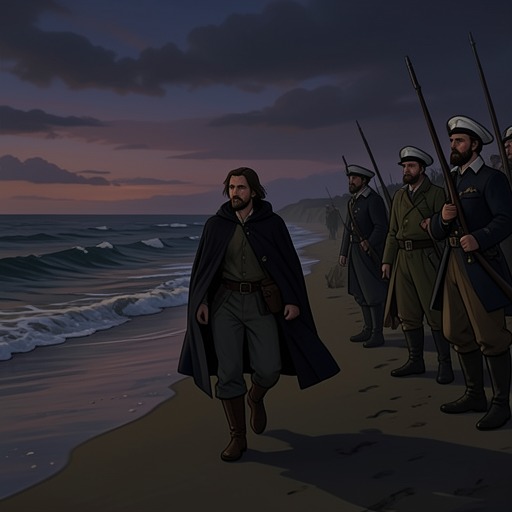
The suspicion reaches its climax as Elmer crosses the backs of the Crocodiles, using lollipops to make a bridge. The monkeys’ noise suddenly stops, and a much larger uproar approaches: the Tigers, Rhinoceros, Lions, Gorilla, monkeys, and other animals are moving together, led by the two extremely angry Wild Boars. They have concluded that the strange activity is a trick and that the invader must be after their Baby Dragon. Their fear has shifted from an uncertain report about peels and a missing rock to a definite accusation and a collective pursuit.
As Elmer places the seventeenth lollipop for the last Crocodile, a boar spots the route across the river and identifies the Crocodiles as a bridge. Elmer reaches the opposite bank just as one Wild Boar jumps onto the first Crocodile. At that moment, the Baby Dragon runs from the bushes, recognizes that Elmer has come to rescue him, and urges him to hurry because the boar and the others are coming across. Elmer takes out his jackknife and begins cutting the rope that holds the Baby Dragon. The animals’ mistaken account thus converges with the real stakes of Elmer’s journey: they are right that he has come for the Dragon, but wrong to treat the rescue as an invasion.
Meaning of the Misreading
The episode’s comedy depends on an uneven distribution of knowledge. The Wild Boars notice genuine details, and their early reasoning about the Tangerines is sensible within the information they possess. What they lack is the connecting fact that a traveler is using those objects and distractions to cross the island. Their explanations repeatedly turn uncertainty into confidence: a doubtful report becomes a sign, an animal’s absorption becomes suspicious behavior, and several unrelated diversions become a coordinated trick.
The misunderstanding also gives the animals their own motives and line of action. They confer, disagree, revise their suspicions, assign the Mouse to watch the Ocean Rocks, and pursue the intruder they believe threatens the Baby Dragon. They are not merely scenery for Elmer’s ingenuity; their mistaken interpretation shapes the obstacles he faces and helps drive the action toward the river crossing. The irony is that the tactics that help Elmer get through Wild Island also make his presence harder to conceal. By the time the animals identify the Crocodile bridge, their imagined invasion and Elmer’s actual rescue have arrived at the same place, but they have not acquired the same meaning.